

Japan Bullet Train | 日本新干线特急列车线上预订

Kyoto Station: Shinkansen Guide with Map, Lockers, Restaurants, Tokyo and Osaka Access

blog
2025-03-27
2025-12-04
Kyoto Station: Shinkansen Guide with Map, Lockers, Restaurants, Tokyo and Osaka Access

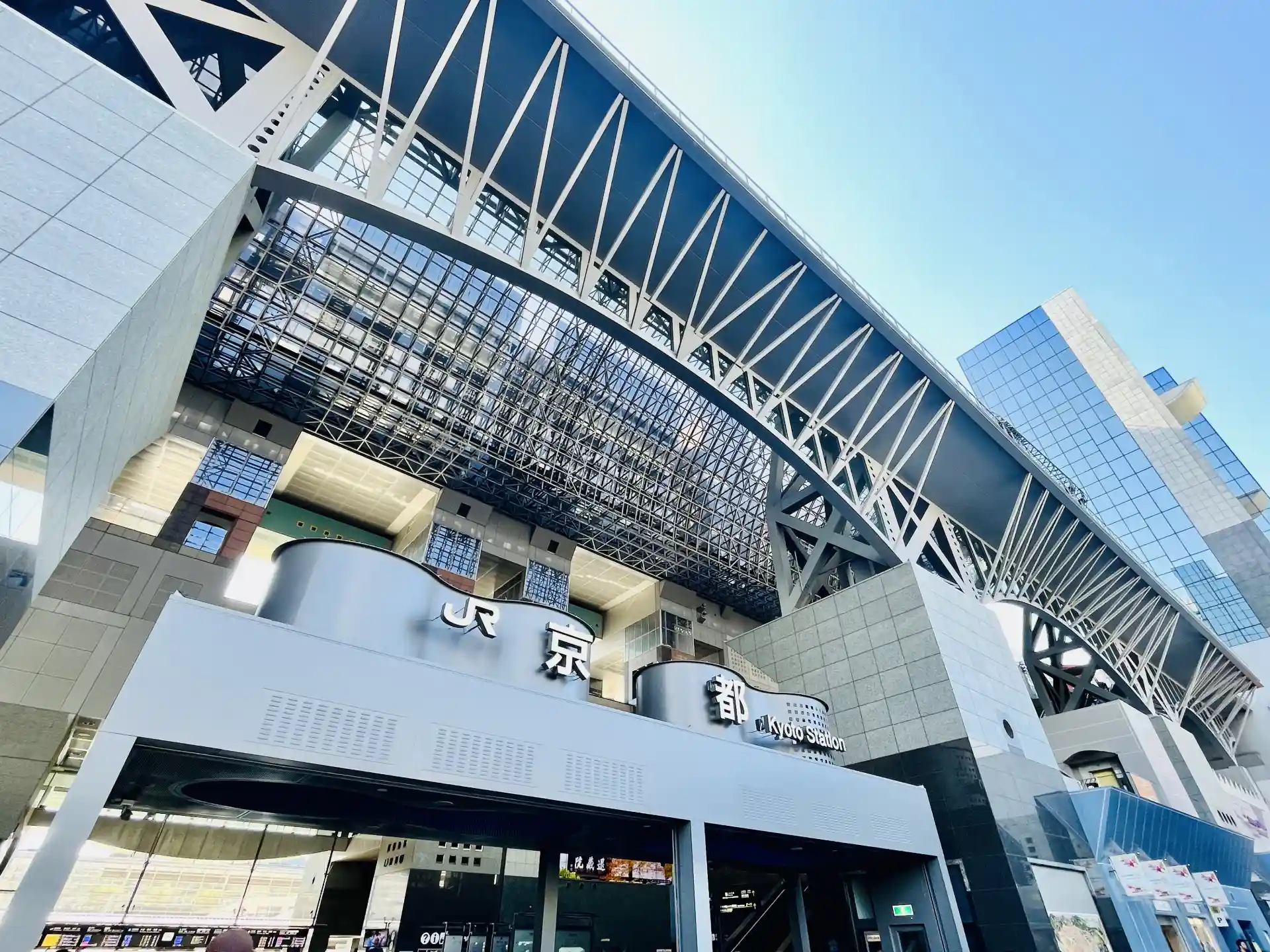
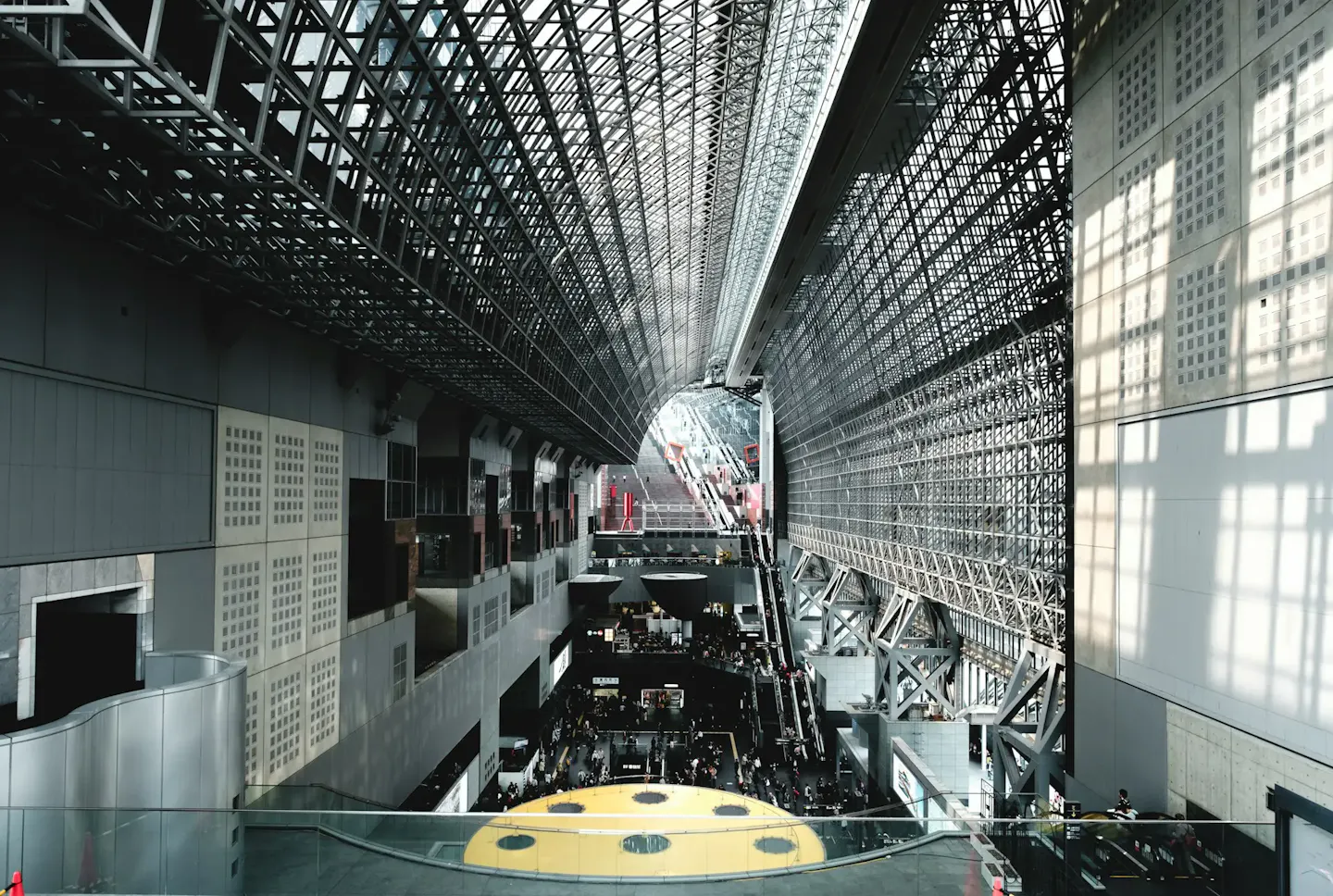
Kyoto Station connects visitors to Japan's ancient capital. The modern building opened in 1997. It serves Shinkansen, local trains, subways, and buses. Over 300,000 travelers use the station daily.

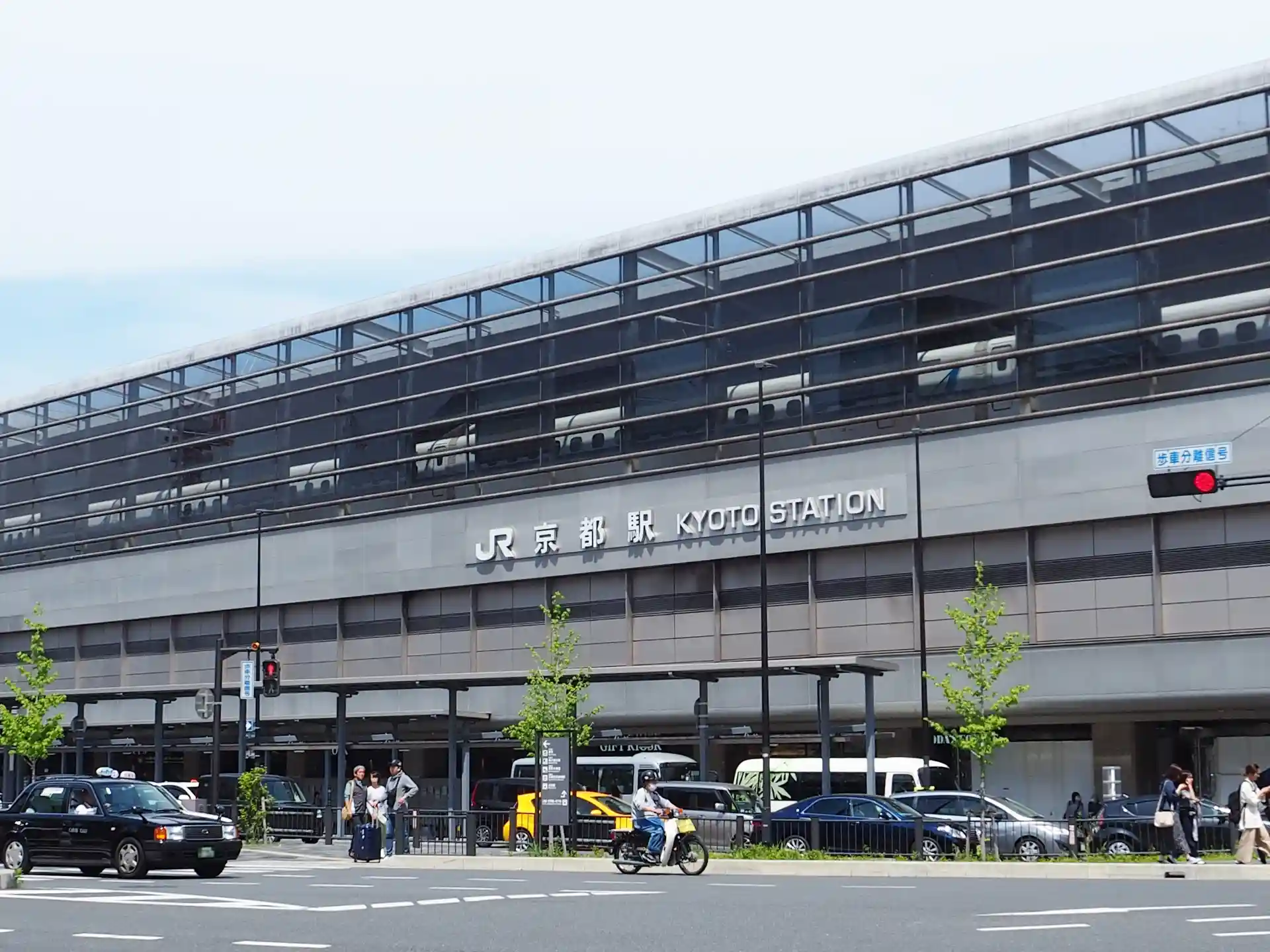
The station divides into two sides. Karasuma (north) serves city destinations. Hachijo (south) serves Shinkansen passengers. Understanding this split makes navigation easier.

Kyoto Station Overview

Key Facts and Layout

Kyoto Station sits in central Kyoto's Shimogyo Ward. The building contains hotels, restaurants, and shopping areas. JR West, Kintetsu Railway, and Kyoto Subway all operate here.

The station handles Tokaido Shinkansen and local JR lines. Most city buses depart from the north terminal. Many hotels stand within walking distance. Luggage storage, ATMs, and tourist information help international visitors.

Karasuma (North) and Hachijo (South) Sides

Kyoto Station divides into two sides.

  • Karasuma Side (North): Faces downtown Kyoto with Kyoto Tower directly across. Underground Porta shopping connects to subway entrance. Main bus terminal serves routes to temples and attractions. Stays busy with tourists and commuters throughout the day.
  • Hachijo Side (South): Faces a slightly less crowded area with many hotels and roads, and generally sees fewer sightseeing buses than the north side. Shinkansen gates located on this side for bullet train access. Kintetsu Railway entrance and highway bus terminal for airport routes. Easier navigation for travelers with luggage.

Use Karasuma for city sightseeing and temples. Use Hachijo for Shinkansen and long-distance travel.

How to Board the Shinkansen at Kyoto Station

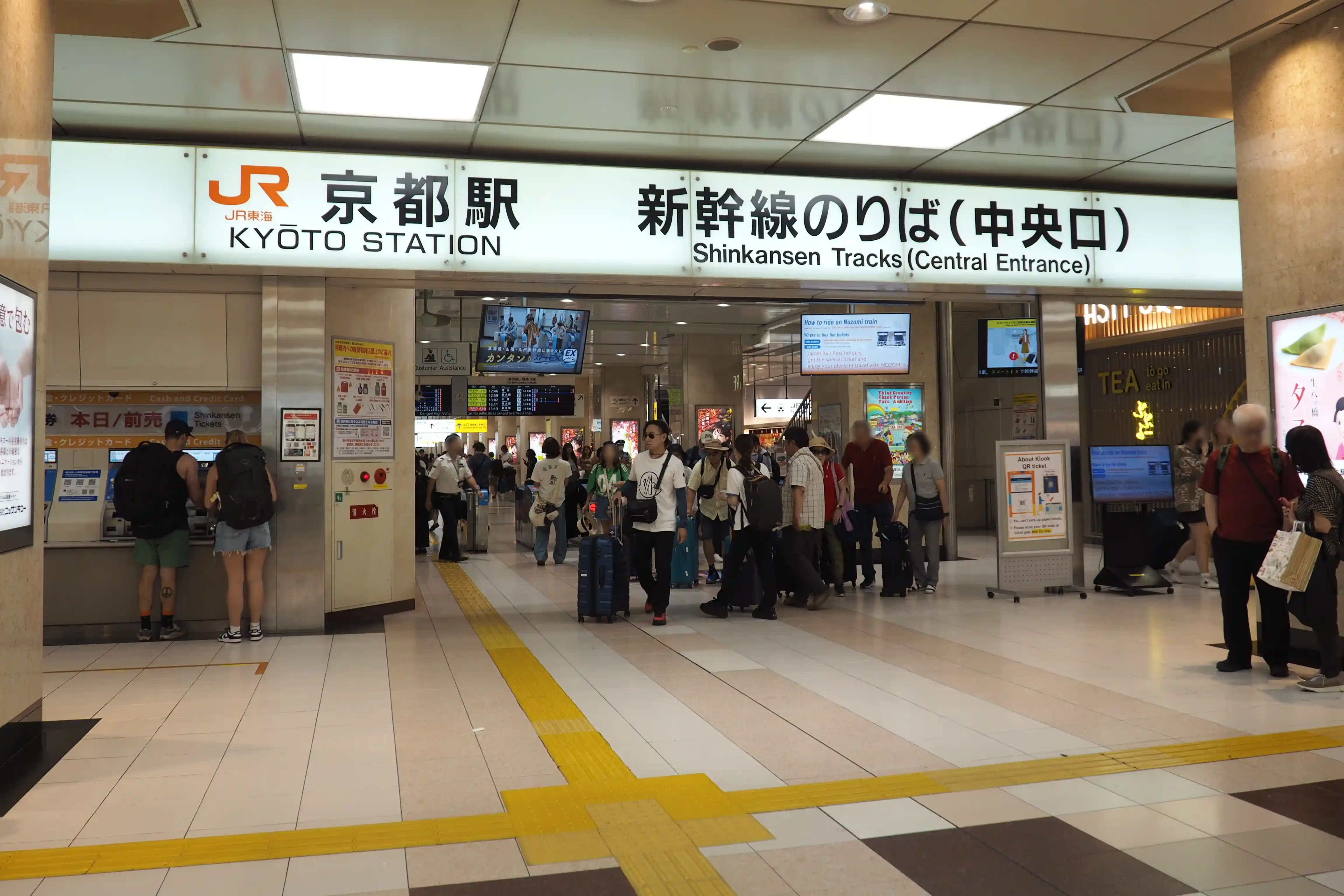
Shinkansen Ticket Gates

Central Gate for the Shinkansen at Kyoto Station with clear overhead signs and passengers moving toward the gates

Kyoto Station has multiple Shinkansen ticket gates:

Gate Name

Floor

Location

Best For

Shinkansen Central Gate

2F

Main gate when coming from the Karasuma (north) side or Central Exit. Also convenient for transferring to/from Kintetsu Railway.

Easiest to access from the Karasuma side.

Shinkansen Hachijo Gate

1F

Main gate on the Hachijo (south) side. The shortest route for passengers entering from outside the station to board the Shinkansen.

Easiest to access from the Hachijo side.

Shinkansen Hachijo East Gate

1F

Located on the Hachijo side, slightly east of the Hachijo Gate (toward the Nara Line platforms).

Easiest to access from the Hachijo side.

Shinkansen Central Transfer Gate

2F

Dedicated transfer gate for passengers arriving on JR local lines.

Most convenient when transferring from JR local lines.

Shinkansen East Transfer Gate

2F

Dedicated transfer gate for passengers arriving on JR local lines, located further east along the concourse.

Most convenient when transferring from JR local lines.

Note: The Shinkansen Central Gate is different from the Central Exit (Karasuma Exit) on the north side of Kyoto Station.

Although their names are similar, the Shinkansen Central Gate is actually located on the Hachijo (south) side of the station, near the Shinkansen platforms.

Shinkansen Platforms

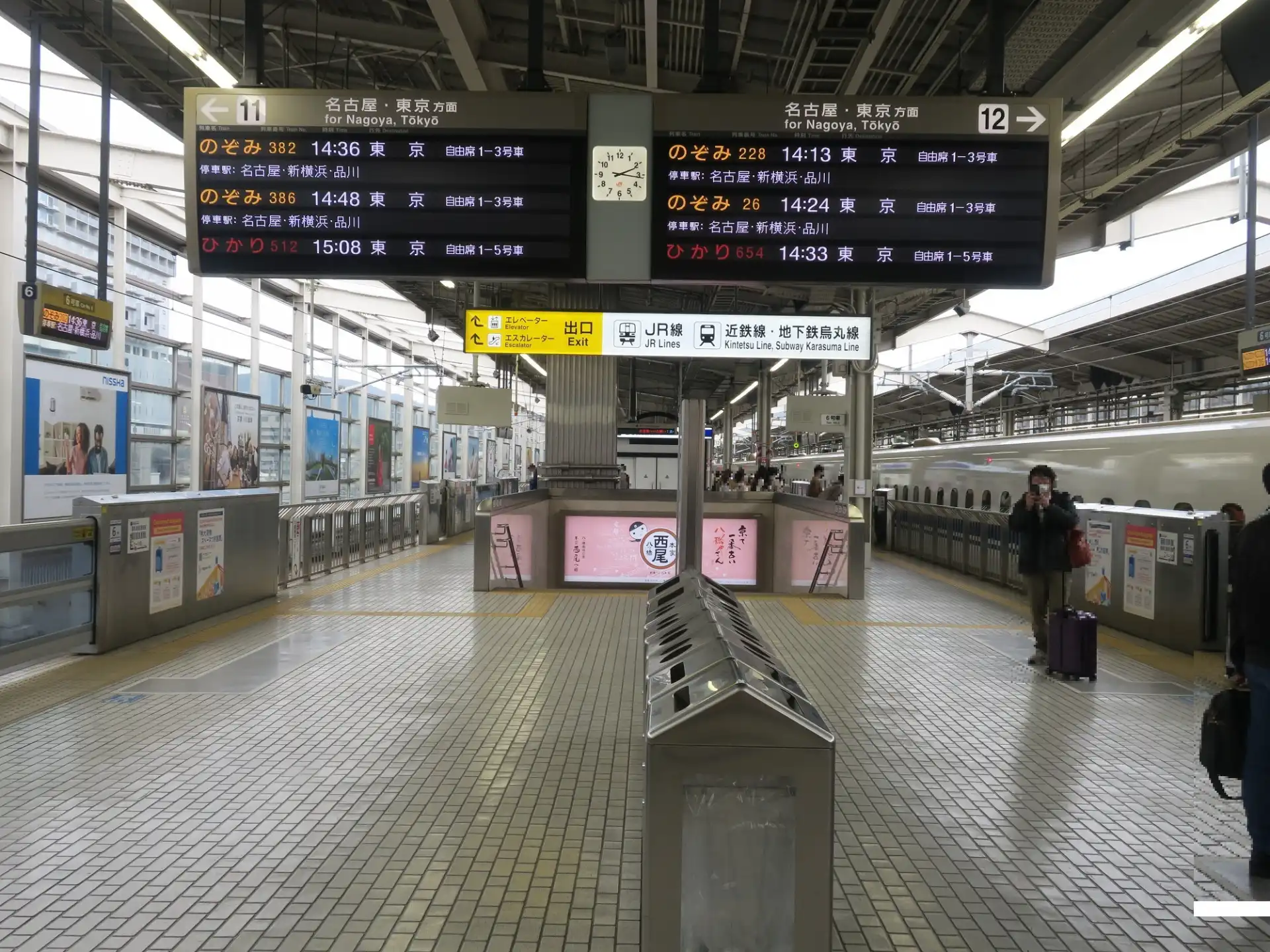
Eastbound Shinkansen platform at Kyoto Station with signs for tracks 11 and 12 and the departure information

All Shinkansen platforms at Kyoto Station are on the 3nd floor and located on the Hachijo (south) side:

Boarding the Shinkansen

Shinkansen train at Kyoto Station platform with passengers waiting to board, showing the edge of the platform and station building in the background

Arrive at Kyoto Station about 15–20 minutes before your Shinkansen departure (a little earlier in peak seasons and holidays).

Enter through any Shinkansen gate using both your basic fare ticket and limited express (Shinkansen) ticket. After passing the gate, follow the station signs and the information printed on your ticket to find your platform and car number.

For a full step-by-step guide with photos (tickets, gates, platforms, and boarding tips), please see our detailed article:

How to Get on the Shinkansen at Kyoto Station: Step-by-Step Guide.

Japan Bullet Train

Kyoto Station Exits and Floor Map

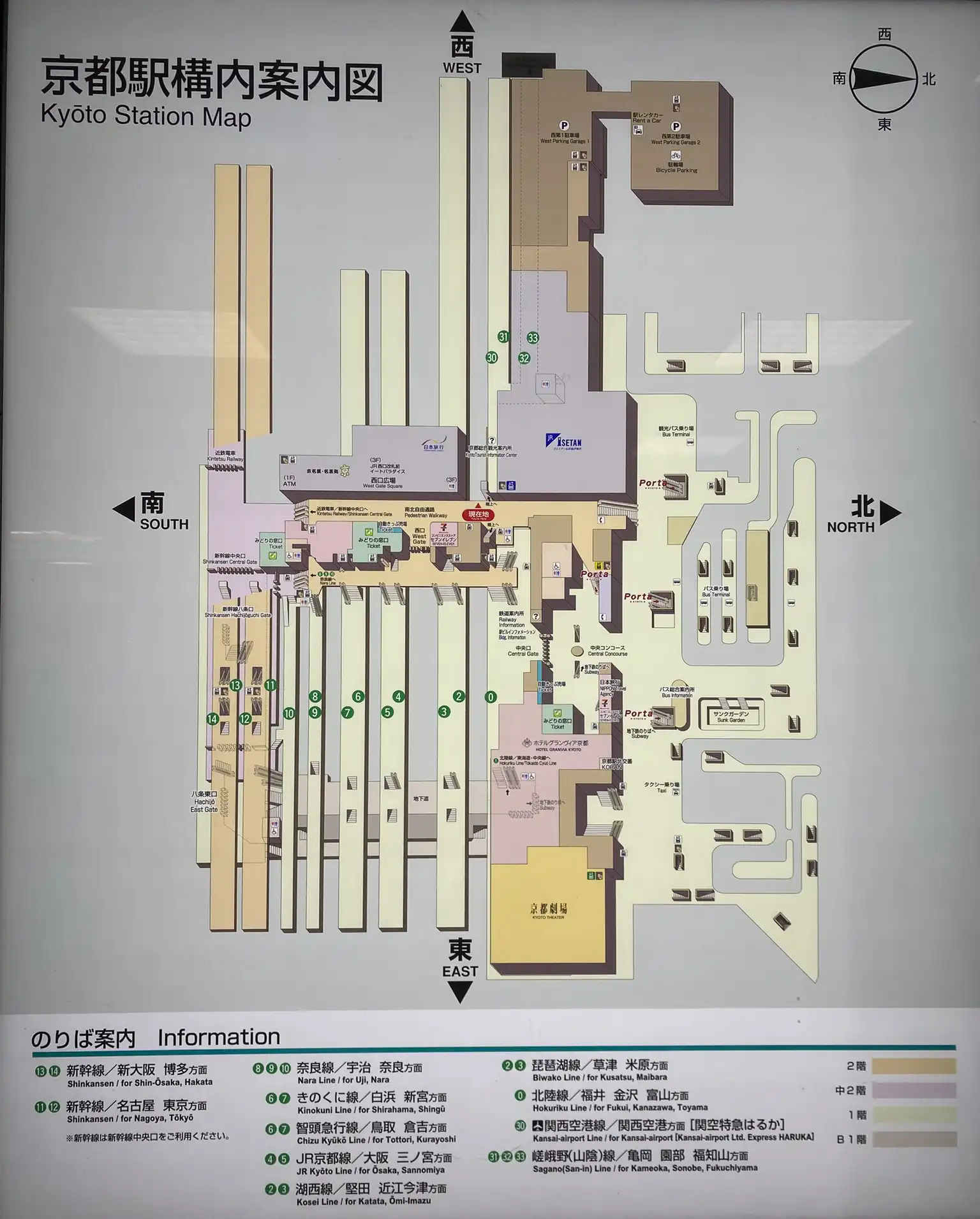
Station Map

Kyoto Station map showing the station layout, entrances, platforms, and facilities for travelers navigating the building

Kyoto Station functions as a three-layer complex, making it easier to understand when grouped into upper, middle, and lower levels.

Upper levels (around 2F and above)

The upper floors include the Shinkansen concourse and platforms, the Kintetsu Railway gates and platforms, and the north–south pedestrian corridor.

These levels also connect to department stores, hotels, dining areas such as the ramen street, and the elevated Skyway observation corridor.

Middle level (1F)

The ground floor serves as the main hub for JR local line gates, central concourses, and direct access to the north (Karasuma) and south (Hachijo) exits.

City buses, taxis, and many street-level shops and facilities are reached from this level.

Lower levels (B1–B2)

The underground levels contain the Porta underground shopping mall, passageways running beneath the station, and access routes to the subway platforms.

Travelers can move between north and south sides while staying indoors and out of the weather, which is convenient for those carrying luggage.

How to Transfer Inside the Station

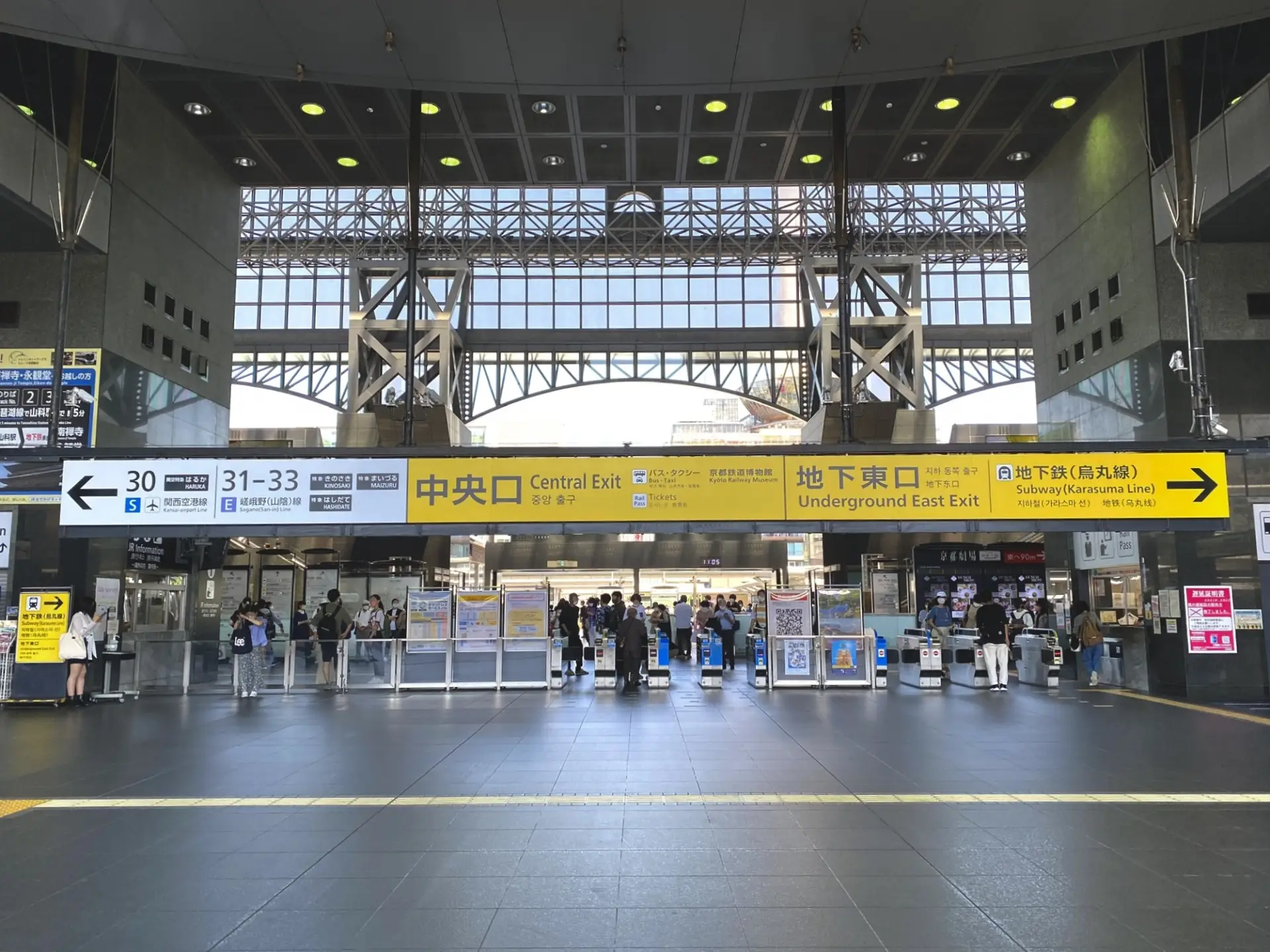
Kyoto Station Central Exit area with signs for Shinkansen, JR, and Karasuma Subway Line

JR Lines

JR Lines Transfers from Shinkansen to JR local lines take about 5–10 minutes. Use the "Shinkansen Transfer Gate" to go directly to the local lines without exiting outside.

  • Platforms 0–10: Tokaido Line (Osaka/Kyoto) and Nara Line (Fushimi Inari/Nara).
  • Platforms 31–33: Sagano Line (Arashiyama).

Subway Karasuma Line

Subway entrance is on B1 beneath Karasuma side. Transfers usually take 5–10 minutes. Follow subway signs down to B1. Shijo station serves downtown shopping; Karasuma Oike connects to business areas.

Kintetsu Railway

Kintetsu operates from 2nd floor on Hachijo side. Transfer takes about 5–10 minutes. Follow signs at upper concourse. Separate tickets required. Trains serve Tambabashi and offer alternative route to Nara.

Bus Terminal

Main city bus terminal is outside Karasuma exit. Transfer takes 5–10 minutes. Multiple stops serve Kinkakuji, Ginkakuji, Gion, and Kiyomizu-dera. Stop letters and route numbers can change; check current info when boarding.

Getting Around Kyoto

Kyoto City Area Access (Gion, Arashiyama, Fushimi Inari)

Traditional street on the Kiyomizu-dera approach in Kyoto, with preserved wooden buildings along the stone-paved slope

From Kyoto Station, it’s easy to reach the city’s most popular sightseeing spots using JR trains or city buses.

  • Gion: Head to the city bus terminal on the Karasuma (North) side, or take the Karasuma Subway Line to Shijo and walk.
  • Arashiyama: Take the JR Sagano Line (San’in Line) toward Saga-Arashiyama.
  • Fushimi Inari: Take the JR Nara Line toward Inari Station.
  • Kiyomizu-dera: Head to the city bus terminal on the Karasuma (North) side.
  • Kinkakuji: Head to the city bus terminal on the Karasuma (North) side.

Travel to Major Cities (Tokyo, Osaka, Hiroshima)

Kyoto to Tokyo

Iconic Shibuya Scramble Crossing with pedestrians and neon lights in Tokyo

Take the Tokaido Shinkansen from Kyoto Station to Tokyo Station. Most trains to Tokyo depart from Platforms 11–12.

Kyoto to Osaka

Street scene in Osaka’s Shinsekai area with lanterns, kushikatsu shops, and Tsutenkaku Tower in the background

Reach Osaka either by the JR Tokaido Line or by the Shinkansen from Kyoto Station to Shin-Osaka. Shinkansen services to Shin-Osaka typically depart from Platforms 11–12.

Kyoto to Hiroshima

Historic Hiroshima atomic bomb Dome standing amid modern city buildings

The Sanyo Shinkansen provides a smooth connection from Kyoto Station to Hiroshima. Direct services (via Shin-Osaka) usually depart from Platforms 13–14.

Airport Access (Kansai Airport KIX & Itami Airport)

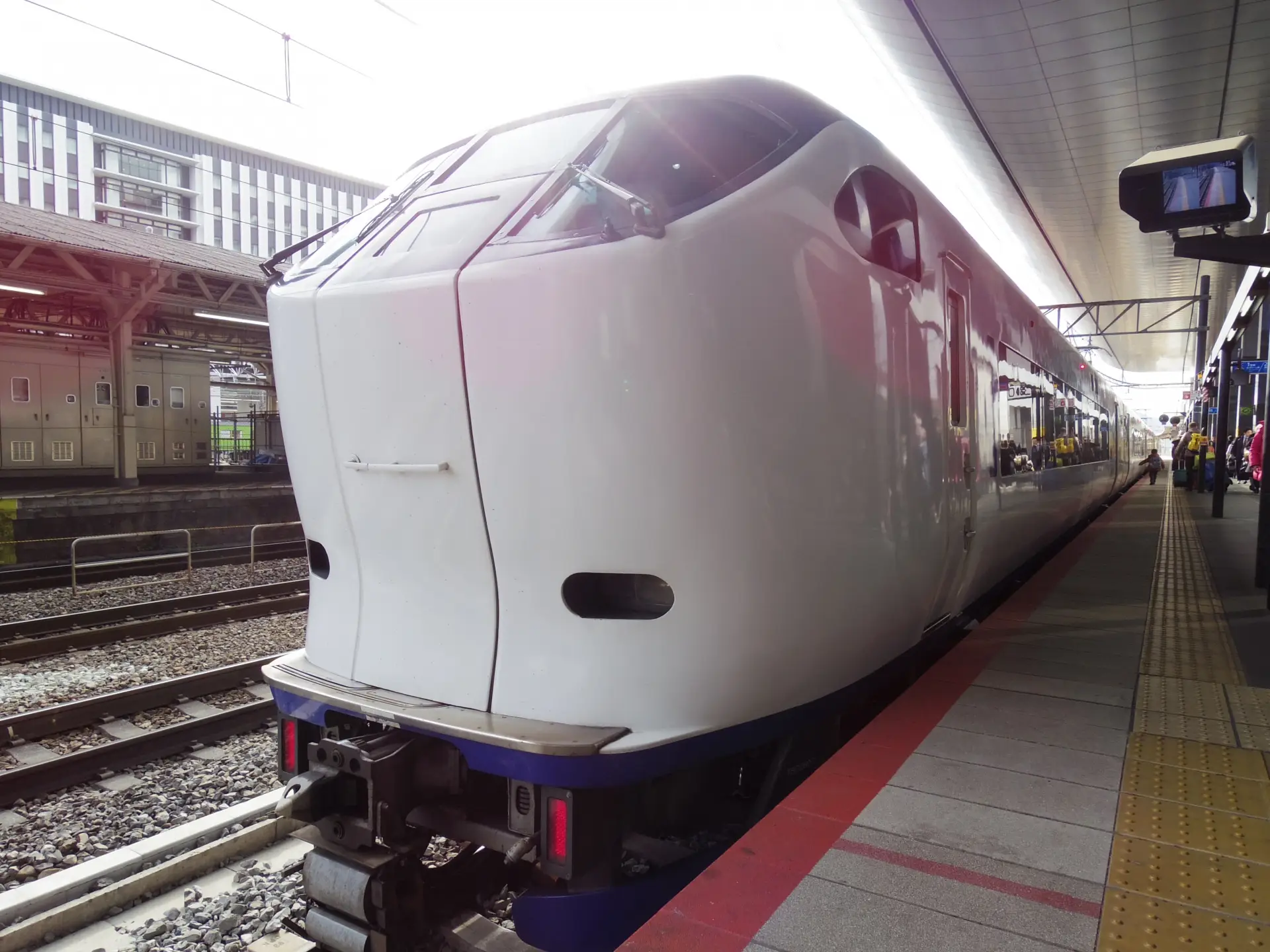
Haruka Limited Express train waiting at Kyoto Station platform

Kansai International Airport (KIX)

The easiest and most reliable way to reach Kansai International Airport is the JR Haruka Limited Express, which mainly departs from Platform 30. The ride takes about 75–80 minutes, with trains running roughly every 30 minutes — a comfortable and convenient option when traveling with luggage.

Highway buses also depart from the Hachijo side and offer a lower-cost alternative, taking 85–100 minutes depending on traffic.

Osaka International Airport (Itami)

Itami Airport is accessible by limousine bus from the Hachijo side. The trip takes around 50–60 minutes. This airport handles domestic flights only.

Facilities and Services for Travelers

Luggage Storage

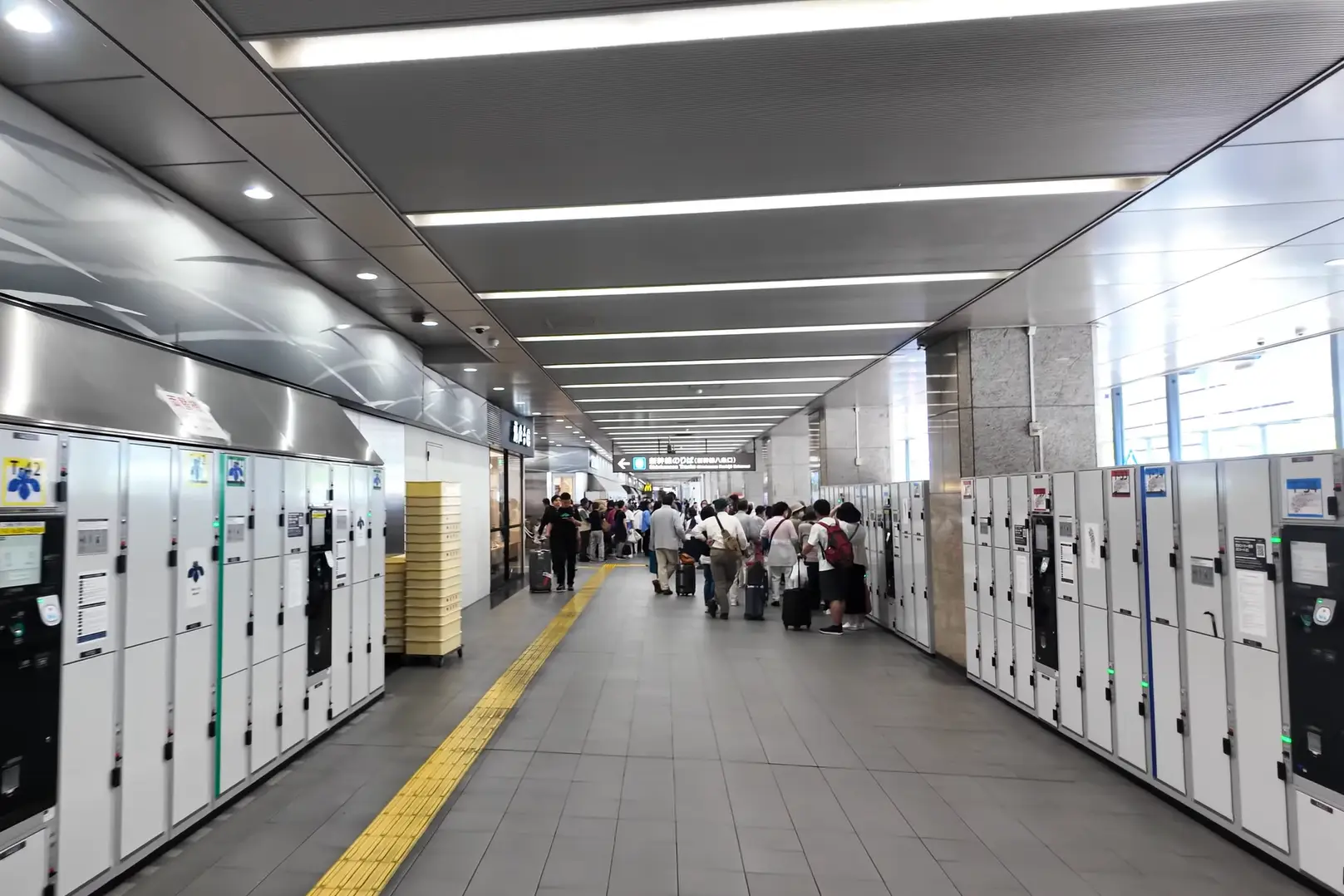
Luggage storage lockers by the Kyoto Shinkansen platform, convenient for travelers

Kyoto Station has a very large number of coin lockers — several thousand in total — located both inside the JR ticket gates and outside in public areas.

Lockers outside the ticket gates are the easiest to use, as they do not require a train ticket.

Karasuma (North) Side – Convenient for City Sightseeing

  • Main Karasuma Area (1F): approx. 400 lockers
  • Less-crowded area (1F): approx. 250 lockers
  • Porta Underground Entrance (near Central Gate): approx. 70 lockers
  • North–South 2F Walkway (near West Gate): approx. 500 lockers
  • Taxi Stand Area (outside Karasuma Exit): approx. 700 lockers

Hachijo (South) Side – Best for Shinkansen Users

  • Along the Hachijo-side walkway: approx. 1,500 lockers

    This is one of the largest locker zones in the station and usually the most reliable place to find availability.

There are more than 500 lockers inside the gates, mainly near JR transfer corridors and platforms. These are useful if you are already inside the paid area or connecting between trains.

Most lockers accept both IC cards and cash. Large suitcases are easiest to store on the Hachijo (South) side, where extra-large lockers are more common. Lockers fill up quickly on busy days, so check the south side first. If everything is full, use the station’s staffed luggage storage services.
ATMs and Currency Exchange

Money exchange service for international travelers at Kyoto Station with multilingual signage

Kyoto Station offers easy access to ATMs throughout the building, including a large cluster near the Hachijo Exit. Many machines support international cards, making cash withdrawals simple for overseas travelers. Currency exchange counters are also available inside and around the station.

IC card machines are located across the station as well, allowing visitors to purchase or top up Suica or ICOCA for smooth travel on trains, buses, and even some shops.

Tourist Information Centers

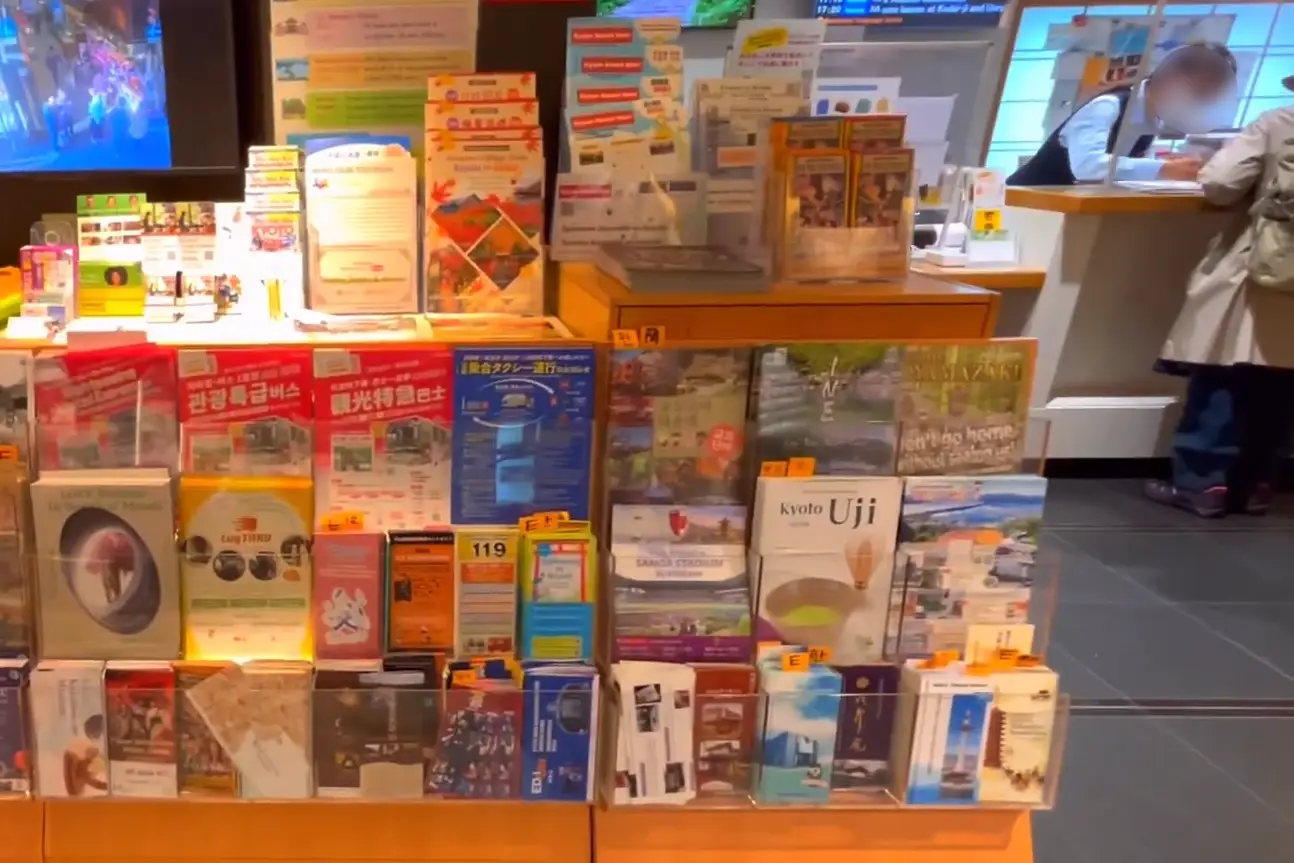
Tourist brochures for international visitors at Kyoto Station’s tourist information center

The Kyoto Tourist Information Center on the second floor provides support for international visitors, with multilingual staff offering maps, travel advice, and assistance in English, Chinese, Korean, and more.


The newer KYOTO Travel Center on the first floor near the Hachijo Exit offers additional services such as tour arrangements, luggage support, and rentals like strollers and mobility aids.


Both centers also share information on cultural activities and can help arrange experiences such as tea ceremonies or kimono rentals, making them useful resources for first-time visitors.

Wi-Fi and eSIM Options

Free Wi-Fi is available in designated areas of Kyoto Station, including around ticket gates, waiting areas, and major facilities like Isetan, Porta, and The Cube. Registration may be required, and speeds can vary during busy times.

Japan Wireless offers nationwide Pocket Wi-Fi rentals, which can be booked online and picked up at airports or delivered to hotels. For a SIM-free option, Japan Wireless eSIM provides reliable coverage and activates immediately upon arrival in Japan.

Dining, Shopping and Highlights Inside Kyoto Station

Dining at Kyoto Station

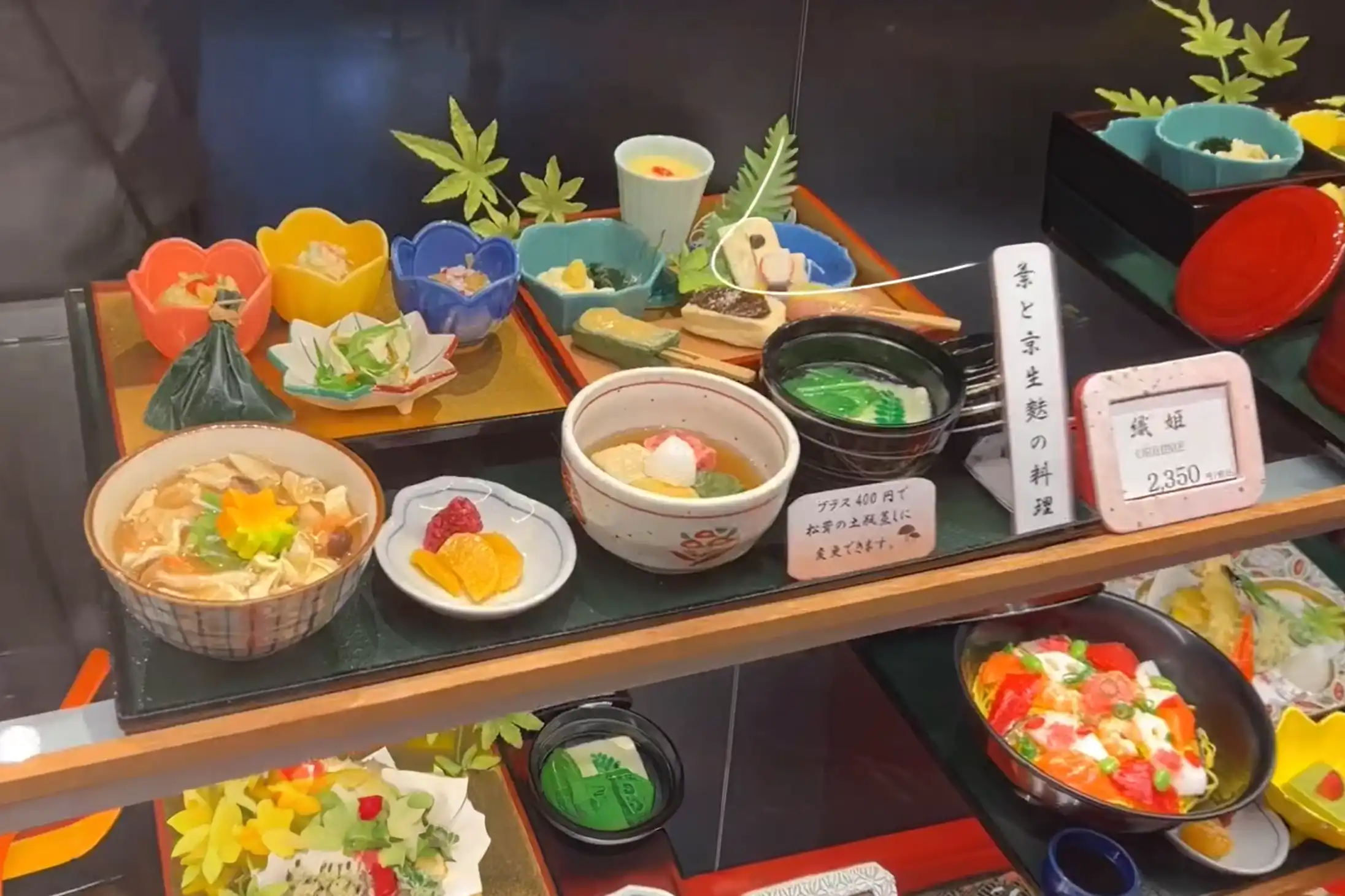
Kyoto-style cuisine sets displayed in a restaurant case at Kyoto Station, featuring several traditional dishes

Kyoto-style cuisine sets displayed in a restaurant case at Kyoto Station, featuring several traditional dishes

Kyoto Station offers a wide range of dining options, allowing travelers to choose meals based on their schedule, taste, and budget.

Restaurant Areas Overview

Location

Name

Description

Kyoto Station Building 10F

Kyoto Ramen Koji

A famous ramen floor featuring regional ramen styles from across Japan.

Kyoto Station Building 11F

Porta Sky Dining

A restaurant floor offering a mix of Japanese, Western, and Chinese cuisine.

Porta Underground Mall (B1F)

A budget-friendly area with cafés, light meals, and quick dining options.

JR Kyoto Isetan 11F

Eat Paradise

A large restaurant zone with many popular eateries in a convenient location.

Kyoto Ramen Koji on the 10th floor is a popular ramen-themed area featuring well-known shops from around Japan. Visitors can enjoy regional specialties such as Hokkaido miso, Hakata tonkotsu, and Kyoto-style ramen.

JR Kyoto Isetan has restaurants across several floors, with the main dining area on the 11th-floor “Eat Paradise.” Its location near the ticket gates makes it convenient for a quick meal before your train.

Shopping at Kyoto Station

Souvenir shop area inside Kyoto Station Porta, displaying boxed sweets and local gifts in a large open market space

Kyoto Station also offers convenient shopping areas for travelers.

JR Kyoto Isetan

This major department store includes a popular basement food hall with Kyoto sweets, regional snacks, and bento boxes, plus fashion and lifestyle shops on upper floors.

Kyoto Porta

Now a combined zone of the former Porta underground mall and The Cube, it features:

  • Underground: Fashion, cosmetics, and cafés.
  • Station Building Floors: Souvenir shops such as “Omiyage Kaido.”

Kintetsu Miyakomichi

Located near the Hachijo Exit, this shopping street connects directly to Kintetsu Kyoto Station and offers about 40 restaurants and souvenir shops—ideal before catching the Shinkansen.

Skyway and Observation Spots

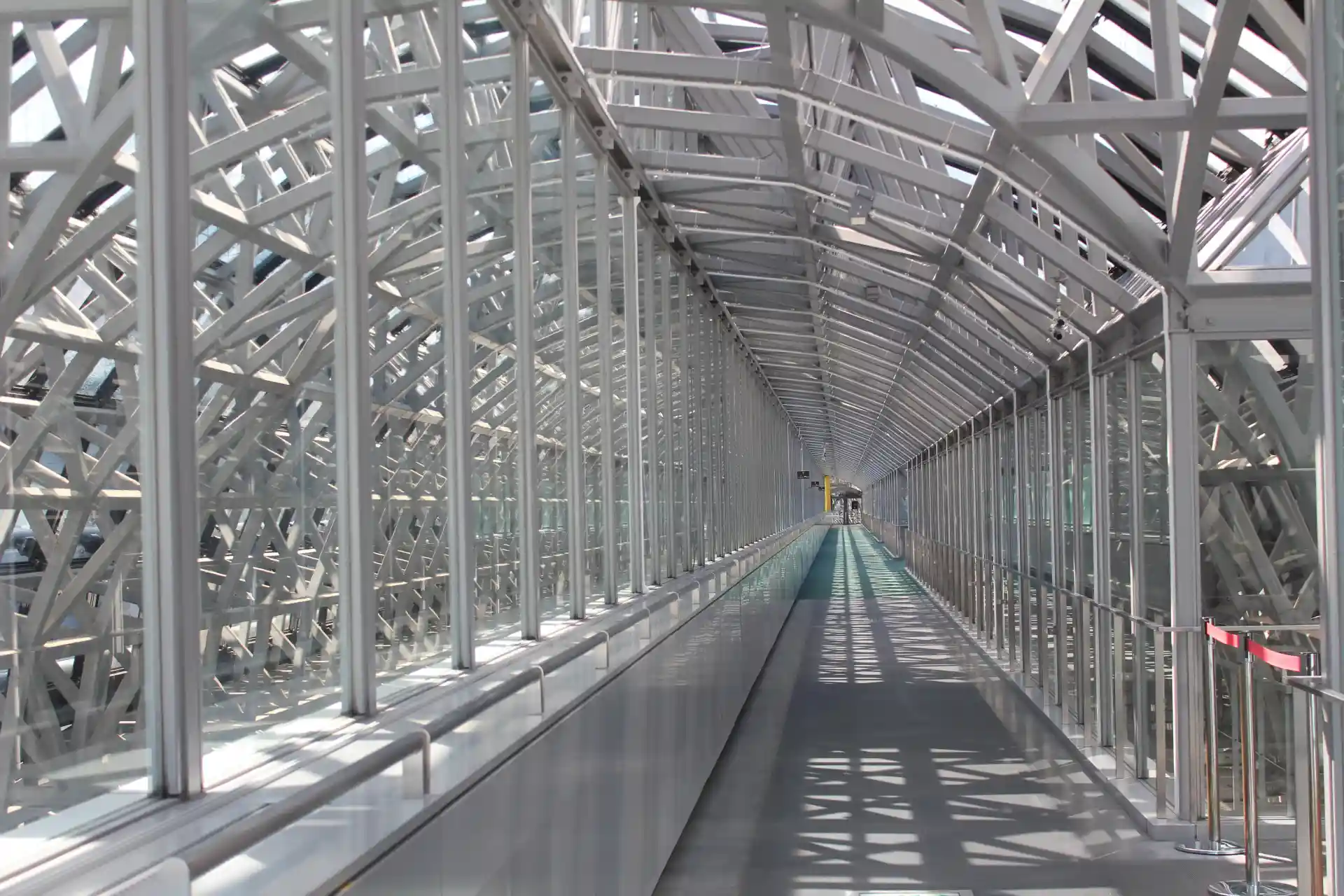
Glass-covered Skyway walkway inside Kyoto Station, showing the long elevated path with steel frames and natural light

The Skyway is located on the 10th floor of the Kyoto Station building and is a glass corridor approximately 147 meters long, connecting the East and West Plazas. Positioned about 45 meters above ground level, it offers scenic views of Kyoto Tower, the city, and surrounding mountains. The corridor features three observation points and is open for free access.

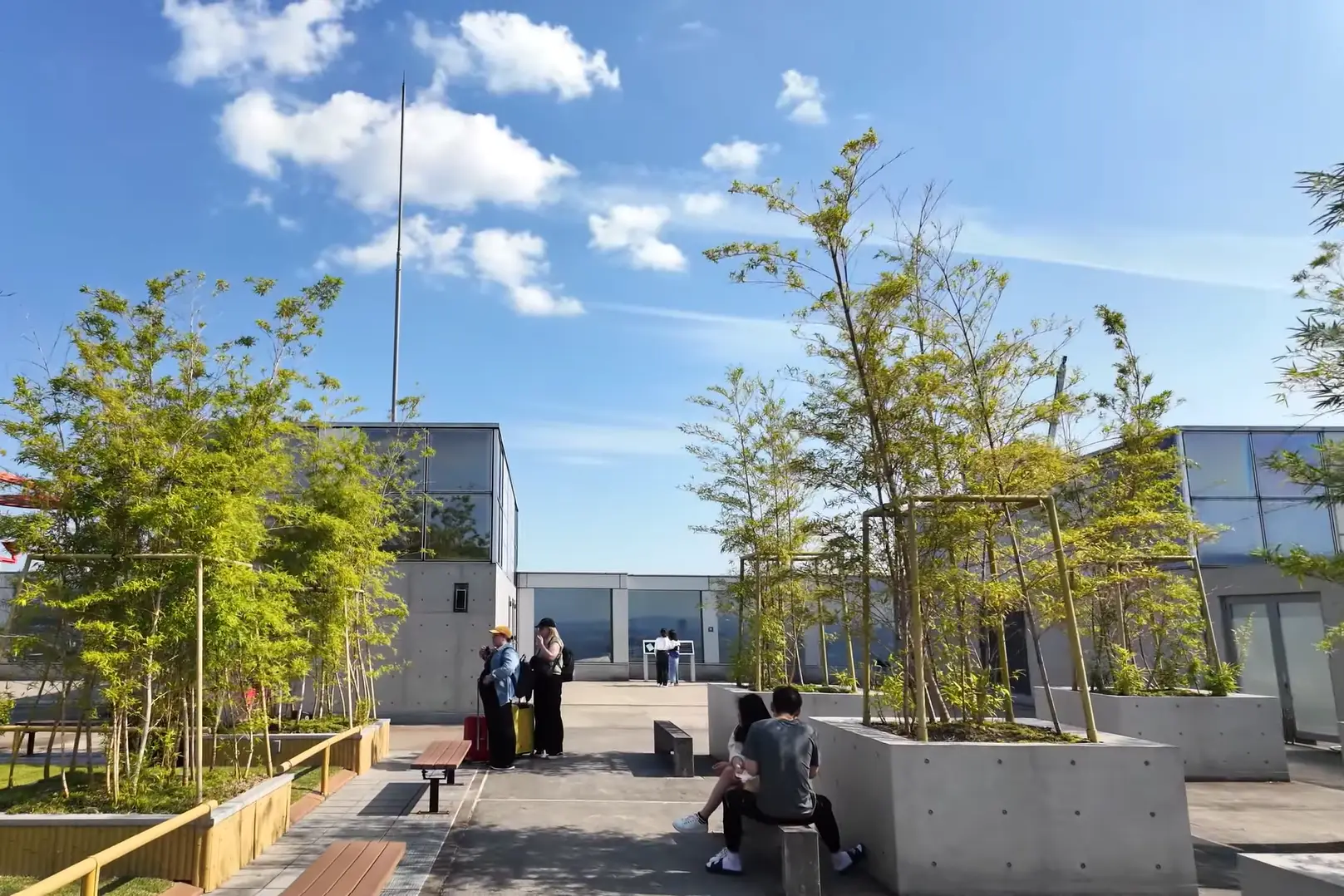
Kyoto Station’s Sky Plaza Happi Terrace rooftop garden, an open-air rest spot with city views

The Grand Staircase is a large staircase with 171 steps inside the Kyoto Station building, leading up to the rooftop viewing area known as Sky Plaza Happi Terrace. This rooftop garden serves as a quiet rest spot for visitors.

Nearby Landmarks

Kyoto Station is a great base for exploring the city. Many top attractions are nearby or can be reached by bus, train, or subway within 15 to 40 minutes, including temples, scenic areas, and cultural landmarks.

Kyoto Tower

Kyoto Station bus terminal with Kyoto Tower in the background, located across from the station’s north exit

Located directly across from the station’s north exit, Kyoto Tower offers panoramic city views and is a great first stop for orientation.

Higashi Honganji & Nishi Honganji Temples

Interior of Nishi Honganji Temple in Kyoto, a UNESCO World Heritage Site

These impressive Buddhist temples are within walking distance of the station. Nishi Honganji is a UNESCO World Heritage Site and features historic halls and serene gardens.

Kinkaku-ji (Golden Pavilion)

Kinkakuji Temple Golden Pavilion in Kyoto reflected in a serene pond surrounded by trees

One of Kyoto’s most iconic landmarks, this gold-covered temple can be reached in about 40 minutes by bus. It’s famous for its beautiful reflection in a tranquil pond.

Kiyomizu-dera Temple

Kiyomizudera Temple in Kyoto with vibrant autumn foliage and panoramic city views

A stunning hillside temple known for its wooden stage and sweeping city views. Accessible by bus or train in about 30 minutes.

Fushimi Inari Taisha Shrine

Iconic pathway through the thousand red torii gates at Fushimi Inari Shrine in Kyoto

Famous for its thousands of red torii gates, this shrine is about 10 minutes away via JR Nara Line.

Arashiyama

Serene walking path through the Arashiyama Bamboo Grove in Kyoto

This scenic district with bamboo groves, temples, and river views is about 20–30 minutes away via the JR Sagano Line.

Gion District

Two women dressed as geisha walking through Kyoto’s historic Gion district

Kyoto’s historic geisha district, known for its traditional wooden architecture, can be reached by bus or subway in around 20 minutes.

Ginkaku-ji (Silver Pavilion)

Ginkakuji Temple’s Silver Pavilion with a traditional Japanese garden and pond in Kyoto

Located in northern Kyoto, this Zen temple and its moss garden are accessible by bus in about 35–40 minutes.

Ryoan-ji Temple

Famous Kyoto rock garden at Ryoan-ji Temple with carefully placed stones and raked gravel

Home to Japan’s most famous rock garden, this Zen temple is reachable by bus or subway in about 40 minutes.

Nanzen-ji Temple

Sanmon gate at Kyoto’s Nanzen-ji Temple framed by colorful autumn leaves

A large temple complex with traditional gates and aqueduct ruins, Nanzen-ji is about 25–30 minutes away by subway.

Book Your Shinkansen Tickets

Japan Bullet Train operates online booking for foreign travelers. The English-language platform covers all major Shinkansen routes. Customer support operates in multiple languages.

Visit the website and browse available routes. Select Kyoto as your departure station. Choose your destination and travel date. View available trains with clear prices. Enter passenger details and complete secure payment. Receive a QR code by email.

Online booking eliminates station ticket office waiting. You can compare train options easily. Book seats in advance for peace of mind. Prices appear in your home currency.

Plan Your Visit

Kyoto Station connects ancient temples with modern Japan. Shinkansen depart frequently to Tokyo, Osaka, and Hiroshima. Local trains reach famous shrines within minutes. The station offers dining, shopping, and observation areas between connections.

Traveling by Shinkansen provides the fastest way across Japan. Reserved seats guarantee your space on busy days. The trains combine speed with comfort and reliability.

Japan Bullet Train makes booking simple for international travelers. The multilingual platform lets you book before reaching the station. Visit the Japan Bullet Train website to secure your seats today.

Japan Bullet Train